
Elektron Analog Heat +FX Review
Categories : Processors and Effects
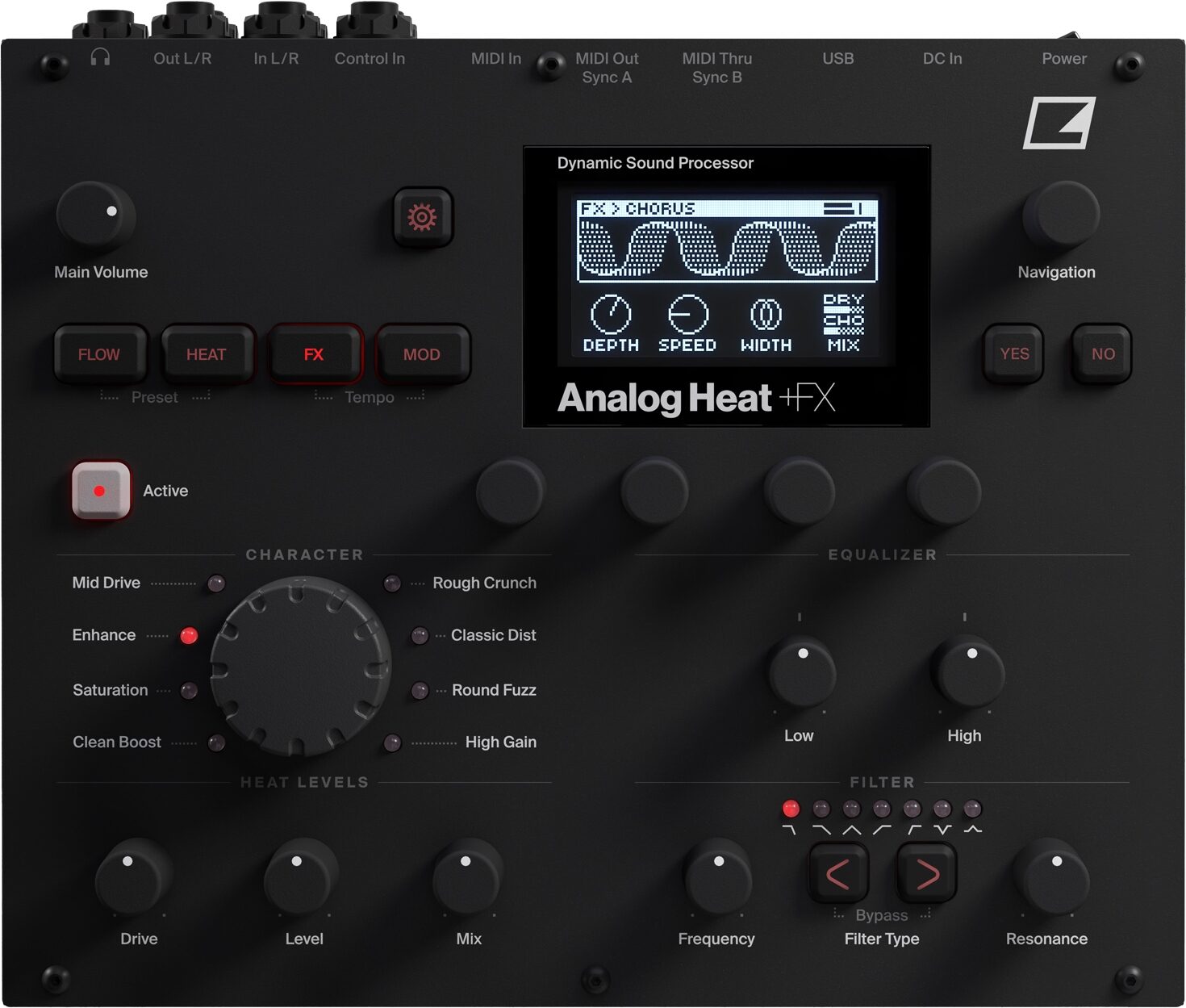
The Elektron Analog Heat +FX is one of the most versatile and creative desktop effects processors available today. Combining eight analog distortion circuits, a powerful multimode filter, analog EQ, a customizable chain of digital effects, and deep modulation capabilities, it is designed to bring warmth, grit, and movement to any signal. Whether used on individual instruments, buses, or the master output, it can transform sterile tracks into expressive, lively recordings. In this review, we’ll explore the Heat +FX in detail, covering its sound, features, workflow, and practical applications in both studio and stage environments.
Design and Build Quality
The Analog Heat +FX follows Elektron’s familiar desktop format: a rugged steel chassis, compact footprint, and solid encoders that feel reliable even under heavy use. The interface features a crisp OLED screen, surrounded by knobs and buttons that make navigating the deep menu system surprisingly straightforward. While many Elektron devices are known for steep learning curves, the Heat +FX strikes a balance between depth and accessibility, giving you immediate hands-on control of essential parameters like drive, filter cutoff, resonance, and EQ, while hiding advanced options just a few menu presses away.
The build inspires confidence. It is heavy enough to stay planted on a desk or stage table, yet portable enough to carry in a backpack. For touring musicians, the unit feels like a piece of gear that could withstand repeated setup and teardown without issue.
Core Analog Processing
The heart of the unit is its Heat block, a section dedicated to coloration and tone shaping. It consists of three components: the distortion circuits, the multimode filter, and the EQ. Let’s break them down.
The Eight Distortion Circuits
Each distortion circuit offers a distinct sonic character. Together, they cover everything from subtle saturation to extreme destruction:
- Clean Boost — Transparent gain that can drive signals without adding obvious coloration. Useful as a preamp or to push signals into the filter.
- Saturation — Warm harmonic content with a subtle tube-like feel. Perfect for adding body to vocals, pads, or entire mixes.
- Enhancement — Brightens the signal with harmonic emphasis in the upper midrange and highs. Great for bringing clarity to synths or guitars.
- Mid-Drive — Focused crunch in the mid frequencies. A natural fit for drums, bass, and leads that need to cut through a mix.
- Rough Crunch — More aggressive, adding bite and thickness. Excellent for electronic drums or industrial textures.
- Classic Dist — Inspired by guitar pedal-style distortion. Rich, full-bodied, and musical.
- Round Fuzz — Thick, fuzzy saturation with a woolly low-end character. Suits synth basslines or lo-fi guitar layers.
- High Gain — The most extreme setting, delivering screaming distortion, high harmonics, and compression-like sustain. Perfect for experimental sound design.
These circuits are the soul of the Heat +FX. They add genuine analog character that plugins often struggle to replicate. The subtle circuits are particularly useful for mastering and mixing, while the heavier ones are playgrounds for electronic musicians and sound designers.
Multimode Analog Filter
The filter section includes seven types: low-pass, high-pass, band-pass, band-stop, and more. With adjustable resonance, it can produce smooth tonal shifts or sharp, screaming sweeps. Because it is analog, it has a character of its own—rounded, musical, and harmonically rich when pushed. Combined with modulation sources, it becomes a powerful tool for rhythmic or evolving textures.
Two-Band Analog EQ
The final stage of the Heat block is a simple but effective two-band EQ. High and low shelves let you balance the output, cut unwanted harshness, or emphasize bass and air. While basic, it is very handy for quick adjustments, especially in live situations.
Digital Effects Chain
What elevates the Heat +FX above its predecessor is the inclusion of a modular digital FX chain. The chain can hold multiple modules in any order, allowing you to design a custom signal path. Available modules include:
- Compressor — Adds punch, evens dynamics, and tightens drums or synths.
- Reverb — Spacious and lush, suitable for subtle room ambience or expansive pads.
- Delay — Clean and versatile, capable of synced rhythmic echoes or long feedback tails.
- Chorus — Adds stereo width and shimmer.
- Warble — A standout effect emulating tape wow and flutter, ideal for lo-fi textures.
- Bits — A bitcrusher for crunchy, digital artifacts and retro grit.
- Bass Focus — Tightens or enhances the low-end of a mix.
- Noise Gate — Useful for cleaning up noisy sources or rhythmic gating effects.
The ability to place these before or after the analog section makes the Heat +FX incredibly versatile. You might run a compressor into the Heat block for aggressive distortion, or process a saturated signal with reverb and delay to create lush, evolving soundscapes.
Modulation and Performance Features
The Heat +FX is not a static processor. Its modulation system brings sounds to life, offering:
- Three LFOs — assignable to virtually any parameter, with multiple waveforms and sync options.
- Envelope Follower — tracks incoming audio and uses it to modulate parameters dynamically.
- Assignable Envelope — for shaping attack, sustain, and release-based modulation.
- CV/Expression Inputs — allowing integration with modular synths or foot pedals.
This depth makes the Heat +FX feel like an instrument. A drum loop can trigger filter sweeps via the envelope follower, while an LFO wobbles drive for movement. With external CV, you can use modular sequencers or pedals to interact with the box in expressive ways.
Connectivity and Integration
The unit is built to slot into hybrid setups with ease. It offers:
- Balanced 1/4" stereo inputs and outputs.
- Headphone out for direct monitoring.
- MIDI In/Out/Thru for synchronization and control.
- USB audio interface capabilities (24-bit/48 kHz, 2-in/2-out).
- Overbridge support for DAW integration.
With Overbridge, the Heat +FX appears as a plugin in your DAW. You can automate parameters, save presets within projects, and route stems through the unit just like any other plugin—except with real analog circuitry in the chain. This makes it both a hardware processor and a virtual plugin, bridging hardware and software worlds seamlessly.
Sound Quality and Character
The Analog Heat +FX shines sonically. Its analog circuits provide harmonics and saturation that feel organic. Subtle drive adds warmth without obvious distortion, enhancing mixes without drawing attention. At higher levels, the circuits can produce ferocious tones full of character and complexity. This analog coloration makes it invaluable for ITB producers seeking an analog finishing touch.
The digital effects complement the analog stage rather than compete with it. The reverb and delay are lush, the chorus is wide, and the Warble effect adds vintage tape-like movement. The blend of analog and digital results in a processor capable of subtle polish or radical transformation.
Example Signal Chains
Drum Bus Crunch
- Compressor → Analog Heat (Mid-Drive) → EQ → Reverb
- This setup tightens drums with compression, adds punchy distortion, balances with EQ, and adds space with reverb.
Lo-Fi Tape Simulation
- Warble → Bits → Analog Heat (Saturation) → Delay
- The Warble adds tape wobble, the bitcrusher reduces fidelity, saturation warms the sound, and delay adds depth.
Master Bus Enhancement
- Analog Heat (Clean Boost) → EQ → Bass Focus → Compressor
- A subtle boost and EQ sweetening, followed by low-end enhancement and compression, result in a polished, glued master bus.
Workflow and Ease of Use
The workflow is smooth once you understand Elektron’s design philosophy. While menu navigation exists, the unit is far less complex than Elektron sequencers. Key controls are always accessible, and the OLED screen provides clear feedback. Preset management is efficient, and saving chains for quick recall during performance is straightforward. This balance of depth and immediacy makes the Heat +FX friendly to both studio and live use.
Strengths
- Authentic analog coloration with eight distortion circuits.
- Powerful digital effects chain with flexible routing.
- Deep modulation and performance features.
- Professional connectivity and DAW integration.
- Versatile for studio, live, and DJ use.
Limitations
- Premium price may be out of reach for hobbyists.
- Limited to stereo operation—no multichannel processing.
- Requires some time to learn the menu structure.
Final Verdict
The Elektron Analog Heat +FX is a rare piece of gear that bridges multiple worlds. It is a mastering enhancer, a performance instrument, a sound design lab, and a DAW-integrated processor all in one. Its analog section provides warmth and grit that can elevate digital productions, while the digital effects chain and modulation unlock endless creative possibilities. For professionals seeking a centerpiece for coloration and expression, the Heat +FX is well worth its premium price. It is not just another effects box—it is an instrument in its own right.
Reviews and Articles
An in-depth 1500 word review of the Elektron Analog Heat +FX desktop effects processor. Covering features, build, workflow, sound, integration, and real-world use cases for producers, DJs, and live performers.
Related Products :


