
Akai MPC Key 37 Review – The Compact Powerhouse for Music Production
Categories : Drum Machines
Introduction to the Akai MPC Key 37
When Akai Professional announced the MPC Key 37 Synthesizer Production Keyboard, it instantly grabbed the attention of producers, beatmakers, and live performers. Blending the tactile MPC workflow with a compact 37-key synth form factor, the MPC Key 37 aims to deliver an all-in-one solution for mobile and studio-based production. But does it live up to the hype? Let’s dive into a detailed review of the Akai MPC Key 37 and explore its capabilities.
Design and Build Quality
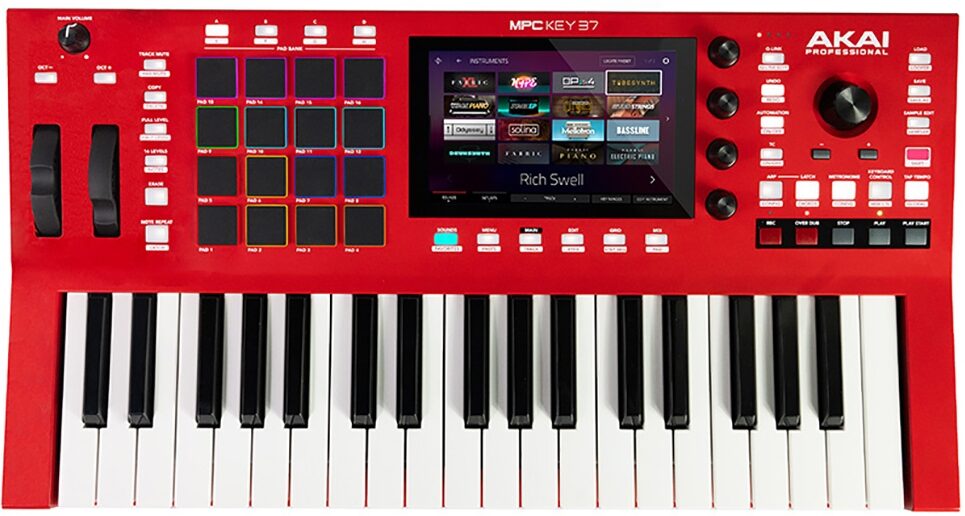
The first thing you notice about the Akai MPC Key 37 is its solid, robust construction. Though smaller than its larger sibling, the MPC Key 61, it doesn’t compromise on durability. The 37 semi-weighted keys feel responsive with aftertouch support, providing a quality playing experience for both synth leads and chord progressions.
The layout is intuitive: to the left, you get pitch and modulation wheels, while the center panel is dominated by a 7-inch color multi-touch screen. The 16 RGB backlit velocity-sensitive pads below the screen retain the signature MPC feel—ideal for finger drumming, chopping samples, and launching clips.
Features and Workflow
At the heart of the Akai MPC Key 37 is the tried-and-true MPC standalone software, giving users the ability to create full tracks without a computer. Whether you’re sequencing, arranging, sampling, or mixing, everything can be done directly from the device.
- Standalone MPC OS 2.12+
- 16 velocity-sensitive pads with note repeat and full level
- 7" capacitive multi-touch display
- Built-in synth engines including Hype, Fabric XL, and TubeSynth
- Wi-Fi and Bluetooth for wireless updates and Ableton Link
- Audio interface functionality via USB
- CV/Gate outputs for modular gear
- Battery-powered option via USB-C power bank (sold separately)
One of the standout features is the inclusion of several built-in synth engines. Hype and Fabric XL provide an expansive range of sounds—ideal for modern trap, EDM, and cinematic compositions. If you’re a sound designer, you’ll appreciate the layer-based synthesis and tweakable parameters available directly from the touchscreen.
Performance in Studio and Live Environments
In a studio setting, the Akai MPC Key 37 shines as a central production hub. The seamless integration with MPC Software 2 means you can start a project on the device and finish it on your DAW—or vice versa. Thanks to the audio interface capabilities via USB, you can route audio directly into your DAW with minimal latency.
For live performers, the MPC Key 37 is a dream come true. The assignable knobs, pad performance modes, and clip launching features allow real-time manipulation of your sets. The onboard SD card slot and USB storage support give you instant access to your sample library without lugging a laptop.
Connectivity and Expandability
Akai ensures the MPC Key 37 doesn’t skimp on I/O. It includes:
- 2 combo XLR/TRS inputs with phantom power
- 2 TRS outputs
- MIDI In/Out
- CV/Gate outputs for modular synths
- USB-A and USB-B ports
- SD card slot
With Wi-Fi and Bluetooth onboard, firmware updates and wireless syncing via Ableton Link are effortless. Plus, the Akai MPC Key 37 can act as a MIDI controller for your DAW, making it a flexible tool both on the road and in the studio.
Sound Quality and Preset Library
The built-in sound engines offer a surprisingly rich sonic palette. From hard-hitting 808s and trap drums to lush pads and cinematic textures, the MPC Key 37’s factory content is impressively curated. Users also gain access to the Splice integration, opening up an ever-expanding world of samples and loops directly from the device.
Akai has also ensured compatibility with MPC Expansion Packs, allowing users to load in third-party content for even more creative possibilities.
Pros and Cons
| Pros | Cons |
|---|---|
|
- Standalone MPC workflow - Excellent keybed and pads - High-quality sound engines - Deep connectivity options - Built-in audio interface - Compact and portable |
- No internal battery - 37 keys may feel limiting for pianists - Price slightly higher than competitors - Learning curve for MPC beginners |
Who Should Buy the Akai MPC Key 37?
The Akai MPC Key 37 is tailor-made for:
- Producers seeking a compact standalone workstation
- Beatmakers who value pad performance and sampling
- Live performers looking for hands-on control
- Musicians who want synth engines and sequencing in one unit
While beginners may need time to get comfortable with the MPC interface, the payoff in creative freedom is worth the investment.
Final Verdict
The Akai MPC Key 37 Synthesizer Production Keyboard is a compact, powerful, and versatile tool that lives up to its MPC heritage. With its rich feature set, excellent build quality, and deep production capabilities, it punches well above its size. Whether you're making beats on the go or setting up a live rig, this is one instrument that won’t disappoint.
For producers who want a standalone solution that doesn’t compromise on flexibility or performance, the Akai MPC Key 37 is a strong contender in 2025’s crowded music production market.
Reviews and Articles
Explore our in-depth review of the Teenage Engineering PO-33 K.O.! Pocket Operator. Discover its features, sound performance, and ideal use-cases.
Explore our in-depth review of the Alesis SR-18 Studio Drum Machine and ASP-1 MKII Sustain Pedal Bundle, focusing on build quality, features, performance, and ideal use cases.
Discover the features, performance, and pros and cons of the Boss DR-3 Dr. Rhythm drum machine in our comprehensive review. Ideal for beginners and portable for live gigs.
Discover our in-depth review of the BeatBuddy 10th Anniversary Edition drum machine. Explore its build, features, performance, and who it's best suited for.
Discover the Teenage Engineering OP–XY, a portable synthesizer with a sequencer, sampler, and built-in features. Read our in-depth review.
Related Products :


