The 7 Best Turntables for DJs (2025)
Categories : Turntables
Note: Specs and features are manufacturer-published figures. Always check the latest documentation before buying. This guide is independent and written for working DJs and beginners alike.
If you’re building or upgrading a deck-based setup in 2025, you’re spoiled for choice. Digital DJing is mature, controllers are powerful, and CDJs are everywhere—yet the allure of real platters refuses to fade. The tactile feedback when you nudge a record, the way a platter settles into speed, and the micro-control you get in the groove are why seasoned selectors and scratch heads still reach for turntables. The right deck becomes an instrument: you cue, blend, drift-correct, cut, and transform time with your fingertips. That’s why the phrase best turntables for DJs isn’t just about spec sheets; it’s about feel, stability, and reliability under pressure.
In this guide, we round up seven outstanding turntables that cover the full spectrum—from the iconic Technics lineage to high-torque club tanks and modern hybrid DVS designs. We’ll compare torque and startup behavior, pitch accuracy and ranges, mechanical isolation, and workflow features like reverse, brake/start adjust, detachable cables, and digital integration. You’ll also get use-case advice for different styles (house/techno, open-format, hip-hop/scratch, mobile/wedding) and practical tips on cartridges, anti-skate, and setup.
Below you’ll find a quick-scan comparison table. After that, each deck gets a deep, real-world review with pros and cons, followed by an extended buyer’s guide and FAQ. The goal: help you match a deck to your technique and environment so you can spend more time mixing—and less time fighting feedback, drift, or temperamental tonearms.
Quick Comparison Table — Best Turntables for DJs
| Model | Drive / Motor | Starting Torque | Pitch Range | Speeds | Start Time | Wow & Flutter | Weight | Notable Extras |
|---|---|---|---|---|---|---|---|---|
| Technics SL-1210MK7 | Direct, coreless | ≈ 1.8 kgf·cm | ±8% / ±16% | 33 / 45 / 78 | ≈ 0.7 s | 0.025% WRMS | ≈ 9.6 kg | Reverse; torque & brake adjust |
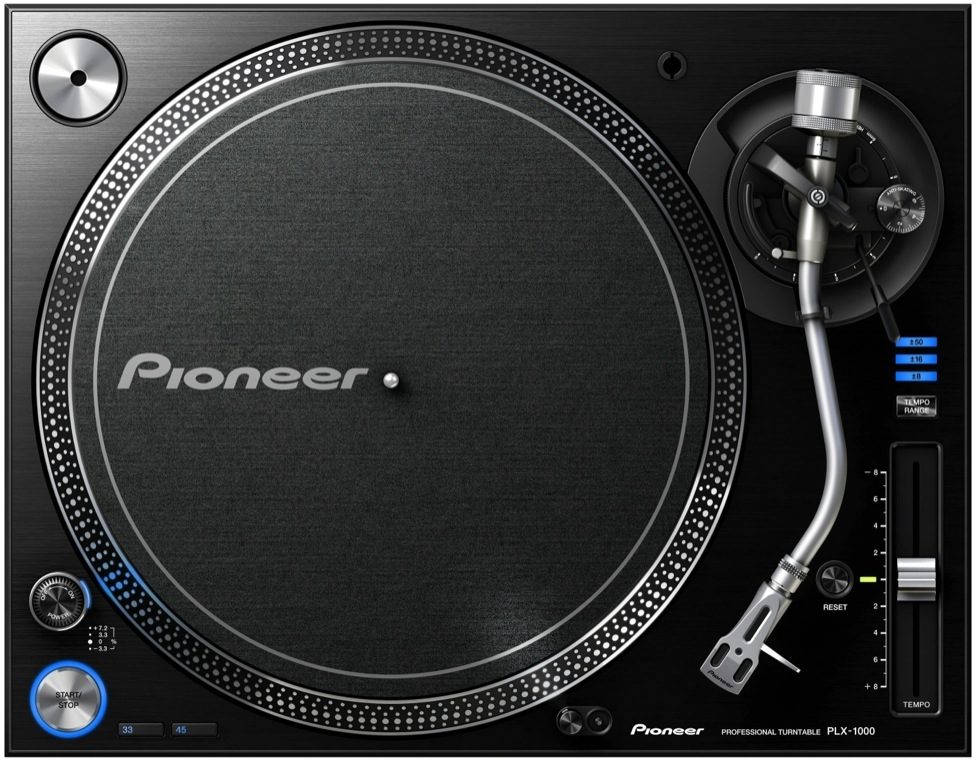
| Pioneer DJ PLX-1000 | Direct, quartz lock | ≥ 4.5 kgf·cm | ±8% / ±16% / ±50% | 33 / 45 | ≈ 0.3 s | ≤ 0.1% WRMS | ≈ 14.6 kg | Detachable power & RCA |
| Pioneer DJ PLX-CRSS12 | Direct, hybrid | Up to ≈ 4.5 kgf·cm | ±8% / ±16% / ±50% | 33 / 45 | ≈ 0.3 s | ≤ 0.15% WRMS | ≈ 12.2 kg | Tone-arm-free DVS, USB-C |
| Reloop RP-8000 MK2 | Direct, quartz | 2.8–4.5 kgf·cm | ±8% / ±16% / ±50% | 33 / 45 / 78 | < 0.2 s | ≈ 0.01% WRMS | ≈ 11.8 kg | Serato-ready pads, OLED |
| Reloop RP-7000 MK2 | Direct, quartz | 2.8–4.5 kgf·cm | ±8% / ±16% / ±50% | 33 / 45 / 78 | < 0.2 s | ≈ 0.01% WRMS | ≈ 11.7 kg | Phono/Line out switch |
| Audio-Technica AT-LP1240-USBXP | Direct, 16-pole/3-phase | > 4.5 kgf·cm | ±10% / ±20% / ±50% | 33 / 45 / 78 | 0.2–6 s adjustable | < 0.1% WRMS | ≈ 12.5 kg | USB + switchable phono/line |
| Numark NTX1000 | Direct, quartz servo | ≈ 4.0 kgf·cm | ±8% / ±16% / ±50% | 33 / 45 | Adjustable | ≤ 0.05% typ. | ≈ 8.5 kg | Budget high-torque option |
Note: Pitch ranges, torque figures, weights and wow & flutter are indicative manufacturer values; small variances exist by unit and setup.
1) Technics SL-1210MK7 : Modern Classic
The SL-1210MK7 is the latest chapter in the most famous DJ turntable line ever built. Rather than chasing spec-sheet extremes, Technics doubled down on what pros love: stability, consistency, and a neutral, predictable feel. The coreless motor eliminates cogging for ultra-smooth rotation, while the digital pitch circuit keeps adjustments precise at both ±8% and ±16%. Add reverse mode, brake/torque trim, a removable target light, and that familiar industrial design, and you’ve got a deck that feels immediately natural in any booth.
In practice, the MK7’s “moderate” torque is a virtue. For house and techno, it gives you a micro-forgiving window when riding blends; little nudges translate linearly, so you can keep long mixes glued without jittery corrections. Scratch DJs sometimes prefer the snap of higher-torque motors, but many battle veterans appreciate how easily the platter speed recovers from drags without overshooting. It’s a different flavor of control: refined more than aggressive.
Mechanically, the MK7 is all about isolation and longevity. The plinth combines robust materials with damping to reduce booth rumble, and the tonearm bearings—properly adjusted—track beautifully across rough pressings. Setup is straightforward: level the deck, balance the arm, set tracking force and anti-skate, and you’re off. Maintenance is mostly periodic: keep the stylus clean, the arm bearings snug (not tight), and the RCA/power cables tidy.
Pros- Legendary feel and layout; zero learning curve in clubs.
- Coreless motor and superb wow & flutter stability.
- Reverse plus torque/brake trim for personalized response.
- Torque is intentional, not “brutal”—some scratchers prefer punchier starts.
- Doesn’t include the flashiest extras (pads, USB), by design.
Best for: Club/house/techno selectors who prize feel and stability; venues where Technics is the shared language among guest DJs.
2) Pioneer DJ PLX-1000 : High-Torque Workhorse
Where the MK7 whispers finesse, the PLX-1000 flexes muscle. This is a high-torque, heavy-chassis, quartz-locked tank aimed squarely at club installs and mobile pros who want iron-fisted startup and rock-solid tracking in loud rooms. Hit start and the platter snaps to speed in roughly a third of a second, shrugging off stylus drag when you back-cue or cut. Detachable IEC and RCA cables make replacement and rack routing simple, and the footprint/layout mirrors the familiar Technics style so every DJ feels at home.
The pitch section is generous: ±8%, ±16%, and an expansive ±50% for performance routines, creative transitions, and half-time/double-time tricks. Quartz lock grants instant 0%—a small touch that matters when you’re playing tracks back-to-back at concert-grade volume. Build quality is unapologetically hefty; the mass contributes to isolation, keeping bass feedback under control when the booth sits on a resonant stage or near subs.
If you’re a mobile DJ who hauls gear, the weight is the price you pay for that stability. But for fixed installs and serious home studios, the heft is a selling point. Day to day, the PLX-1000’s high torque feels confident yet controllable; for scratch and open-format sets, it delivers the “grab” many DJs want when executing fast cuts and drags.
Pros- Big torque with fast start/stop for scratch and juggling.
- Wide pitch ranges including ±50% for routines.
- Heavy, damped chassis helps defeat low-frequency feedback.
- Weight makes transport and quick setup more demanding.
- No integrated performance pads or USB (traditional analog focus).
Best for: Club installs, event companies, and open-format/scratch DJs who want high torque and a familiar, no-nonsense layout.
3) Pioneer DJ PLX-CRSS12 : Hybrid DVS Innovator
The PLX-CRSS12 is the category bender: a premium DJ turntable that plays analog records but can also control DVS without using the tone arm, thanks to Pioneer DJ’s Magvel Clamp system. In Digital Vinyl mode, you put the clamp on a thin control disc and the deck reads platter rotation directly, bypassing the stylus entirely. The result is near zero skip risk even under aggressive scratching and body tricks—gold for battle DJs and anyone who wants the tactile platter feel minus the needle anxiety.
Switch to Analog mode and it behaves like a refined high-torque deck: selectable torque, brisk startup, wide pitch ranges (±8/±16/±50), and pro-grade isolation. An OLED display and thoughtful buttons help with mode switching and range selection, and USB-C provides streamlined connectivity to software ecosystems. It’s the most future-facing turntable on this list: ideal for hybrid performers who play a mix of real vinyl and digital crates in the same set.
There are trade-offs. The clamp workflow adds a small setup step, and purists who live exclusively on vinyl may not need the DVS magic. But for battle stages, festival shows with shaky risers, or clubs where the booth rattles, tone-arm-free DVS is a superpower. If you’ve ever halted a set to recover a needle after a wild cut, you’ll know why this design matters.
Pros- Tone-arm-free DVS control virtually eliminates skip risk.
- Selectable torque, fast start, and wide pitch ranges.
- Smart hybrid workflow: one deck for wax and digital.
- Clamp adds a step; not essential for vinyl-only DJs.
- Premium pricing for features some won’t use daily.
Best for: Scratch/battle specialists and hybrid performers who want DVS security and vinyl authenticity in the same rig.
4) Reloop RP-8000 MK2 : Performance Turntable
The RP-8000 MK2 fuses a serious upper-torque direct-drive with integrated performance controls. Eight multi-function pads along the left flank can trigger cues, loops, sample slots, slicer modes and more in Serato, while an onboard OLED keeps you oriented. If you love DVS but crave a real platter and tonearm, this hybrid workflow can simplify your setup: you can leave the controller at home, put your hands on vinyl, and still punch cue points or loop rolls on the deck itself.
Under the hood, the motor offers adjustable torque in the 2.8–4.5 kgf·cm range, giving you control over platter “feel.” Start/stop is tweakable, the pitch fader is long and stable, and Ultrapitch up to ±50% is there for creative routines. Mechanically the deck is stout, with a damped chassis, rubberized buttons that resist club grime, and a tonearm that tracks confidently when properly set up.
The value proposition is strong. For price comparable to a classic analog deck, you’re getting a performance interface built into the turntable, reducing gear sprawl. The flip side is complexity: more modes to learn, more firmware to keep current, and the usual DVS dependencies (laptop, audio interface or software-compatible mixer). Still, for DJs who straddle the analog/digital divide, the RP-8000 MK2 is a sweet spot where the platter is the controller.
Pros- Integrated Serato pads & OLED—controller functions on a real turntable.
- Adjustable upper torque; Ultrapitch ±50%.
- Solid chassis and club-friendly ergonomics.
- Extra features add complexity if you just want a pure analog deck.
- Best experience is Serato-centric; check mappings for other apps.
Best for: DVS performers who want pads at their fingertips without sacrificing the feel of a true turntable.
5) Reloop RP-7000 MK2 : Pro Value Pick
Strip away the pads from the RP-8000 and you land on the RP-7000 MK2, a pro-spec deck that concentrates on fundamentals: a strong, adjustable motor; wide pitch ranges; rugged build; and a handy phono/line switch so you can plug straight into modern mixers or powered speakers. It’s one of the best values in a “serious” turntable—a workhorse that handles loud booths, takes a beating, and stays locked to tempo.
Torque is adjustable in the upper range, making it comfortable for both blend-oriented mixing and heavier scratch work. The pitch fader is accurate across ±8/±16/±50, and the quartz lock gives you dead-on 0% when you need it. Isolation is excellent for the price; the feet and mass help resist bass feedback on hollow stages, and the tonearm bearings are tight enough to inspire trust without being fussy.
For DJs who already have pads on a mixer or prefer to handle hot cues from software, the RP-7000 MK2 keeps the deck simple and solid. If you’re kitting out a venue, this model’s combination of cost, durability, and familiarity makes it an easy recommendation.
Pros- Upper-torque performance at a very competitive price.
- Phono/line switch simplifies cabling in the real world.
- Ultrapitch ±50% for multi-genre and creative sets.
- No integrated pads—strictly a “decks and mixer” workflow.
- Slightly less polish in fit/finish than some pricier flagships.
Best for: Working DJs and venues that want pro performance without overspending on extras.
6) Audio-Technica AT-LP1240-USBXP : Feature-Packed Tank
The AT-LP1240-USBXP (or audio technica 120 usb) wears a lot of hats: scratch-ready direct-drive deck, vinyl archiving turntable (thanks to USB), and flexible line/phono output platform that pairs with almost any mixer or speaker chain. It’s built on a proven “super-OEM” architecture—translation: big torque, a heavy plinth, substantial isolation, and durable controls. Pitch options go deep (±10, ±20, ±50), reverse is on tap for tricks, and start/stop is adjustable from snappy to dramatic. If you’re running a mobile rig where every piece has to cover multiple jobs, this Swiss-army approach is compelling.
The switchable preamp means you can feed line-level directly to a PA or an all-line mixer without a separate phono stage; USB is handy for ripping rare records or integrating with computer workflows. In scratch contexts, the motor has the authority to power through drags and recover speed quickly; for blend-centric sets, the platter response is predictable and easy to ride.
Fit and finish are robust; this deck has earned a reputation for taking abuse on the road. The trade-offs are weight (it’s not light) and a design that, while clean, prioritizes durability over minimalist aesthetics. For many DJs, that’s exactly the point.
Pros- USB + switchable phono/line cover many real-world scenarios.
- High torque and adjustable start/stop for scratch and performance.
- Wide pitch options including ±50 for creative mixing.
- Hefty for frequent load-ins/outs.
- Aesthetic leans “industrial tool” more than sleek showpiece.
Best for: Mobile/wedding DJs, versatile home studios, and performers who want one deck that does nearly everything.
7) Numark NTX1000 : Budget High-Torque
The NTX1000 is the gateway to high-torque performance without a premium price tag. It delivers a strong motor, familiar S-arm ergonomics, and the wide pitch ranges (±8/±16/±50) you need for open-format sets, routines, and creative tempo jumps. Start/stop is adjustable so you can dial in snappy battle cuts or slower, more “analog” blends. For newcomers moving up from consumer turntables—or veterans who need reliable backups—the NTX1000 brings pro-style control within reach.
Build quality is honest and purposeful. You don’t get the mass of a flagship, but you do get a stable plinth, properly damped feet, and controls that feel reassuring on a dark stage. In scratch contexts, the motor has enough bite to handle backspins and drags; for blend-oriented sets, the fader tracks evenly across the range and quartz lock nails zero when required.
Is it the last deck you’ll ever buy? Maybe not—but it’s often the first truly capable one. And when budgets are tight (venue installs, community radio, practice rooms), two NTX1000s and a solid mixer form a rig that teaches good habits: cue discipline, platter control, and pitch finesse.
Pros- Strong torque and wide pitch at an approachable price.
- Adjustable start/stop; straightforward, familiar layout.
- Lighter than many flagships—friendlier to transport.
- Less mass means a bit less isolation in hostile booths.
- Fit/finish not as premium as top-tier rivals.
Best for: First serious setups, practice spaces, and backup rigs that still demand real performance.
Buyer’s Guide: How to Choose the Best Turntables for DJs
The perfect deck for you depends on technique, venue, and ecosystem. Use the considerations below to match a model to your real-world needs.
1) Torque & Startup Behavior
Torque describes how forcefully the motor keeps the platter at speed. High torque resists stylus drag during heavy back-cueing and scratch cuts, and it accelerates to 33⅓ quickly. This feels “authoritative” and is favored by many open-format and battle DJs. Moderate torque, championed by Technics, trades brute force for ultra-predictable feel—beloved for long blends in house/techno. There’s no right answer; it’s about whether you want a deck that snaps to your commands or one that glides with you.
2) Pitch Range, Resolution & Fader Feel
Standard mixing is comfortable at ±8% or ±16%. If you juggle genres, do wordplay transitions, or experiment with half-time/double-time blends, ±50% (often labeled “Ultrapitch”) widens your creative window. Equally important is fader quality: a long, smooth throw with consistent resistance lets you make tiny corrections without “stepping.” Quartz lock is handy for snapping back to exact 0% mid-set.
3) Isolation, Mass & Booth Reality
Nightclub physics are messy. Hollow risers resonate; subs make tabletops vibrate; crowd movement sends micro-shocks through everything. Heavier plinths, damped platters, and quality feet help. If your gigs often place decks near subwoofers, prioritize weight and isolation. If you’re mobile, strike a balance between mass and portability—or pack isolation pads/stands to help.
4) DVS & Hybrid Features
Digital Vinyl Systems map platter motion to software playback. If you rely on Serato, rekordbox, Traktor, or VirtualDJ, look for conveniences like line-level outputs (skip external phono stages), USB when needed, or integrated control surfaces (pads, OLEDs). Hybrid innovations like the PLX-CRSS12’s tone-arm-free DVS give you the tactile magic without needle risk—transformational for battles and shaky stages.
5) Connectivity & Serviceability
Detachable IEC power and RCA cables save gigs. A phono/line switch lets you plug into modern mixers or powered speakers with fewer adapters. USB can be a lifesaver for archival work, radio studios, or streaming rigs. Externally accessible pitch calibration and user-serviceable parts are a plus for venues that rack up hours quickly.
6) Tonearm Geometry & Cartridge Choices
S-shaped arms are common on DJ decks for a blend of stability and tracking. Conical styli are rugged for scratching; elliptical and advanced profiles retrieve more detail for audiophile sets but can be less forgiving under heavy hands. Whatever you choose, set vertical tracking force (VTF), anti-skate, and (if available) VTA properly. A correctly balanced arm prevents premature wear and improves skip resistance.
7) Ergonomics & Workflow
Small touches matter: target lights you can actually see in the dark, start/stop buttons that fall under your fingers, and pitch reset where you expect it. If you live on hot cues, consider whether you want pads on the deck (RP-8000 MK2) or on the mixer/controller. Reverse, brake, and torque trims help fine-tune feel per genre and venue.
8) New vs Second-Hand
High-quality turntables can last decades. Buying used can save money, but inspect for tonearm play, platter wobble, uneven pitch response, and noisy RCAs. If a deck lived in a smoky club or was a scratch workhorse, factor in potential bearing and fader service. When reliability is mission-critical (weddings, broadcast), new with warranty is often worth it.
9) Budget Allocation
Don’t spend your entire budget on decks and forget needles, slipmats, isolation, and a proper mixer. A balanced rig—a pair of solid decks, a reliable battle or club mixer with good EQ and faders, and a small cartridge/stylus reserve—beats a single flagship deck paired with cut-corner accessories.
FAQ: Best Turntables for DJs
- Do I need ±50% pitch for DJing?
- Not for standard mixing. ±8% or ±16% covers most club work. ±50% is great for routines, half-time/double-time jumps, and creative mashups. If you perform across many BPM ranges, it’s worth having.
- Which turntable is best for scratching?
- High-torque models like the PLX-1000, RP-8000 MK2, and AT-LP1240-USBXP are popular for their fast starts and platter authority. The PLX-CRSS12 adds tone-arm-free DVS, which virtually eliminates skips in digital sets. That said, many scratch artists still rock Technics for the consistent feel.
- Are belt-drive turntables good for DJs?
- For club DJing and scratching, direct-drive is the standard because it provides stable speed and strong torque. Belt-drive is fine for listening rooms and audiophile use but isn’t ideal for heavy cueing or backspins.
- Do I need a built-in preamp?
- Only if your mixer or interface lacks phono inputs. Decks with switchable phono/line (e.g., RP-7000 MK2, AT-LP1240-USBXP) are convenient for modern setups and quick changeovers.
- What cartridges should I buy?
- For scratch and heavy cueing, conical tips are durable and forgiving. For high-fidelity blends, elliptical or more advanced profiles extract extra detail. Always set VTF and anti-skate to the manufacturer’s spec and keep spares handy.
- How do I prevent feedback on stage?
- Place decks on stable, non-resonant surfaces; use isolation pads or stands; avoid positioning next to subs; keep gain structure healthy; and prefer heavier, well-damped decks for bassy rooms.
- Is the Technics SL-1210MK7 still worth it in 2025?
- Absolutely. Its consistency, isolation, and intuitive feel remain a benchmark. If you value smooth blends and familiar ergonomics, it’s a top choice. If you want maximal torque or hybrid DVS features, consider the PLX-1000 or PLX-CRSS12.
Wrap-Up: Which Deck Should You Buy?
Every model here can anchor a professional booth. If you want the classic, neutral “club” feel, pick the Technics SL-1210MK7. If you crave high-torque punch and a heavy, feedback-resistant chassis, the Pioneer DJ PLX-1000 delivers. For hybrid DVS innovators and scratch specialists, the PLX-CRSS12 is a revelation. Prefer pro performance and value? The Reloop RP-7000 MK2 is hard to beat, while the RP-8000 MK2 adds on-deck pads for controller-style agility. If versatility is your mission, the Audio-Technica AT-LP1240-USBXP covers studio, stage, and archiving. On a tighter budget but still want real torque and club-ready control? The Numark NTX1000 gets you there.
Above all, match the deck to your workflow: your hands, your booth, your music. The best turntables for DJs are the ones that disappear under your fingertips and let the mix speak for itself.
Reviews and Articles
Discover the Stanton T.92 USB Direct Drive Turntable, a reliable and versatile option for DJs and audiophiles alike. Explore its build quality, features, performance, and who it's best suited for.
Explore our comprehensive review of the Technics SL-1200MK7 Direct Drive Turntable with Presonus HD09 Bundle. Discover its build quality, features, audio performance, pros and cons.
Explore our in-depth review of the Replacement Turntable Drive Belt for JVC AL-A10, covering build quality, features, audio performance, and who it's best suited for.
Detailed review of the Audio Technica 120 USB turntable. Learn about features, performance, design, pros and cons, and whether the AT-LP120XUSB is the right choice for DJs and vinyl lovers.
description" content="Looking for the best turntables for DJs? Here are 7 pro-level decks—from Technics, Pioneer DJ, Reloop, Audio-Technica and Numark—plus a detailed features comparison table and buying advice.
Related Products :